Quick Answer: Water heaters leak for several reasons — loose connections, a failing pressure relief valve, a corroded drain valve, internal tank rust, or simply old age. Some leaks are minor and fixable. Others mean the tank has failed and needs to be replaced. No matter the cause, you should never ignore a leaking water heater. Even a small drip can cause major water damage over time.
At Top Shelf Plumbing Pros, water heater leaks are one of the most urgent calls we receive. What our customers often notice is a puddle near the base of the unit — and they’re not sure whether it’s a serious problem or something minor. In our experience, that uncertainty is exactly when you should call a professional.
This post is going to walk through every common cause of water heater leaks, how to identify which one you’re dealing with, and what the fix looks like. We’ll be honest about when it’s repair-worthy and when replacement is the only smart move.
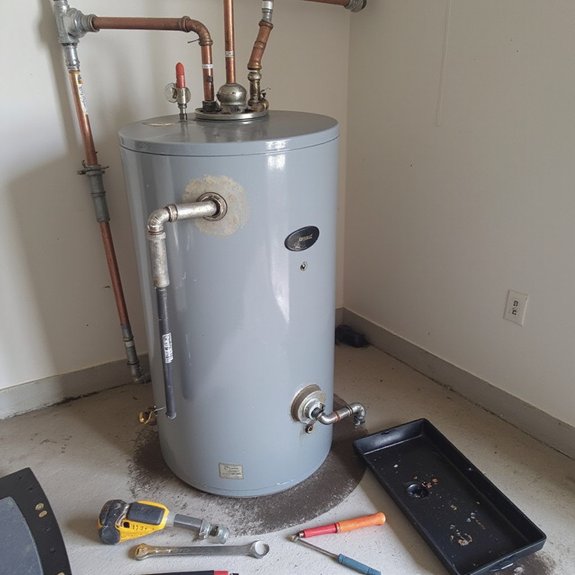
Why You Should Never Ignore a Water Heater Leak
We’ve seen homeowners put a towel under a leaking water heater and just check it every few days. That’s a mistake. Even a slow drip can cause significant damage to your flooring, subfloor, and drywall — especially in a utility closet where the leak might not be immediately visible.
In our experience, the worst cases of water damage we’ve seen started with a small leak that got ignored. We’re talking $10,000 to $20,000 in repairs. A leaking water heater demands prompt attention from a licensed plumber — not a wait-and-see approach.
Cause 1: Loose or Corroded Inlet/Outlet Connections
At the top of your water heater are two pipe connections — one for cold water coming in, one for hot water going out. These connections can loosen over time due to thermal expansion and contraction. When they loosen, water can drip or seep around the fittings.
This is actually one of the more common causes we see — and it’s one of the easiest to fix. Tightening the connection or replacing a worn fitting is a quick repair. If the corrosion around the connection is extensive, we may need to cut out a section of pipe and re-solder or use new fittings.
How to identify it: The leak appears at the top of the unit near the pipe connections, not at the base. You may see white mineral deposits or rust staining around the fittings.
Cause 2: A Failing Pressure Relief Valve (T&P Valve)
The temperature and pressure relief valve — or T&P valve — is a safety device on every water heater. Its job is to release water if the pressure or temperature inside the tank gets too high. If this valve is faulty or has been triggered too many times, it can start to drip or leak on its own.
This is actually a safety-critical component. A T&P valve that doesn’t work correctly is a serious concern — it’s your last line of defense against a dangerous pressure buildup inside the tank. If the valve is leaking, it needs to be tested and likely replaced right away.
How to identify it: The T&P valve has a small pipe running down the side of the water heater (the discharge pipe). If there’s water dripping from this pipe or from the valve itself, that’s your clue.
Cause 3: A Corroded or Loose Drain Valve
At the bottom of your water heater is a drain valve. This is used when flushing the tank or draining it for repairs. Over time, this valve can develop a slow drip — either because it’s been opened and closed many times, because sediment has kept it from sealing fully, or because the plastic components have degraded.
What our customers often notice is a small, steady drip from the very bottom of the unit. Sometimes it’s such a slow drip that they don’t realize it’s happening until they spot water staining on the floor.
A leaking drain valve can sometimes be fixed by replacing the valve — a straightforward repair. If the valve itself is fine but sediment is preventing it from fully closing, a flush may help.
Cause 4: Internal Tank Corrosion
This is the serious one. If the tank itself has rusted from the inside out, water will eventually find its way through. Once the tank has a crack or hole due to internal corrosion, there is no repair. The unit must be replaced.
Internal corrosion is more common in older units and in areas with hard water — which includes Sandy, Utah. As we mentioned in our post on Signs Your Water Heater Is About To Fail, rusty water coming from your hot tap is a warning that internal corrosion may already be underway.
How to identify it: Water pools at the base of the unit with no other obvious source. The water may have a reddish or rust tint. The unit is typically older or has never had its anode rod replaced.
Cause 5: Excessive Pressure Inside the Tank
Water heaters are designed to operate within a specific pressure range — typically 50 to 80 PSI. If your home’s water pressure is higher than that, or if thermal expansion is causing pressure spikes inside the tank, it puts stress on the tank walls and fittings over time. This can eventually cause small leaks or trigger the T&P valve repeatedly.
In our experience, high water pressure is an underappreciated cause of water heater problems. We sometimes install an expansion tank to help manage pressure fluctuations and protect the water heater — as well as other appliances in the home.
Cause 6: Condensation (Not Always a Leak)
Here’s something worth knowing: not all moisture around a water heater is a leak. In some situations — especially when a cold water heater is first starting up, or in humid conditions — condensation can form on the outside of the tank and drip to the floor.
This is more common with new installations or after a period of no use. If the water heater is new or recently installed and you’re seeing moisture, give it a day or two to see if it clears up. If it doesn’t, call us.
How to Find Where a Leak Is Coming From
Before calling a plumber, it helps to do a quick visual inspection. Here’s a simple process we walk our customers through:
- Dry the area around the water heater completely with a towel.
- Wait 30 minutes without using any hot water.
- Check the top connections first — look for wet fittings or drips at the inlet/outlet pipes.
- Check the T&P valve and its discharge pipe on the side.
- Check the drain valve at the bottom.
- Check the base of the tank itself for any seeping water.
This narrows down where the leak is coming from, which helps your plumber get to the problem faster.
| Leak Location | Likely Cause | Repair or Replace? |
|---|---|---|
| Top of unit (fittings) | Loose or corroded connections | Usually repair |
| Side of unit (T&P valve) | Faulty pressure relief valve | Repair (replace valve) |
| Bottom of unit (drain valve) | Corroded or loose drain valve | Usually repair |
| Base of tank (tank itself) | Internal corrosion / tank crack | Replace |
| Outside of tank (moisture) | Condensation | Monitor; likely no action needed |
What Happens If You Don’t Fix a Leak
We want to be clear about this: a leaking water heater will not fix itself. A loose fitting won’t magically tighten. A corroded tank won’t stop rusting. Every day you wait, the problem gets worse.
Beyond the damage to your home, there are safety concerns too. A faulty T&P valve is a real safety risk. A leaking gas water heater near an ignition source is dangerous. These are not situations to put off.
When to Repair vs. Replace
Here’s the honest breakdown of how we think about it:
| Situation | Our Recommendation |
|---|---|
| Loose connection or fitting | Repair — quick and inexpensive |
| Faulty T&P valve | Repair — replace the valve |
| Leaking drain valve | Repair — unless tank is old |
| Internal tank corrosion | Replace — no repair option |
| Unit over 10 years old + leaking | Replace — not worth repairing |
| Unit under 7 years old + minor leak | Repair first, then evaluate |
If your unit is getting up there in age, a leak is often the nudge to move forward with a replacement you were already going to need soon. In that case, it’s worth considering your options — including switching to a tankless system. Check out our comparison of Tank vs Tankless Water Heaters to see what makes sense for your home.
Can Hot Water Running Out Be Related to a Leak?
Yes — if your tank is losing water through a small leak, it’s constantly bringing in new cold water to replace it. That cold water has to be heated, which can slow down your hot water supply and make it seem like you’re running out faster. If you’re dealing with both problems at once, read our post on Why Your Hot Water Runs Out Too Fast alongside this one.
Get Help From Our Team
If your water heater is leaking — even just a little — we strongly recommend calling a professional before it becomes a bigger problem. Our team at Water Heater Repair & Installation in Sandy is experienced with all types of water heaters and will give you a straight answer about what needs to happen.
We serve Sandy, UT and the surrounding communities. Visit our Sandy plumbing services page to learn more or to request a service call.
Frequently Asked Questions
Is a leaking water heater dangerous?
It can be. A faulty pressure relief valve is a safety concern. Gas water heaters leaking near ignition sources present a risk. Any water heater leak should be evaluated promptly by a professional.
Can I use my water heater if it’s leaking?
In the short term, possibly — but we don’t recommend it. A small leak can become a large one quickly. It’s best to turn off the unit and call a plumber as soon as possible.
How do I temporarily stop a water heater from leaking?
If the leak is severe, shut off the cold water supply valve above the heater and turn the unit off. This won’t fix the underlying problem, but it can stop the situation from getting worse until a plumber arrives.
How much does it cost to fix a leaking water heater?
It depends entirely on the cause. A simple fitting repair might cost $100 to $200. A T&P valve replacement is typically $150 to $300. If the tank itself is leaking, replacement starts at $800 and goes up from there depending on the type and size.